
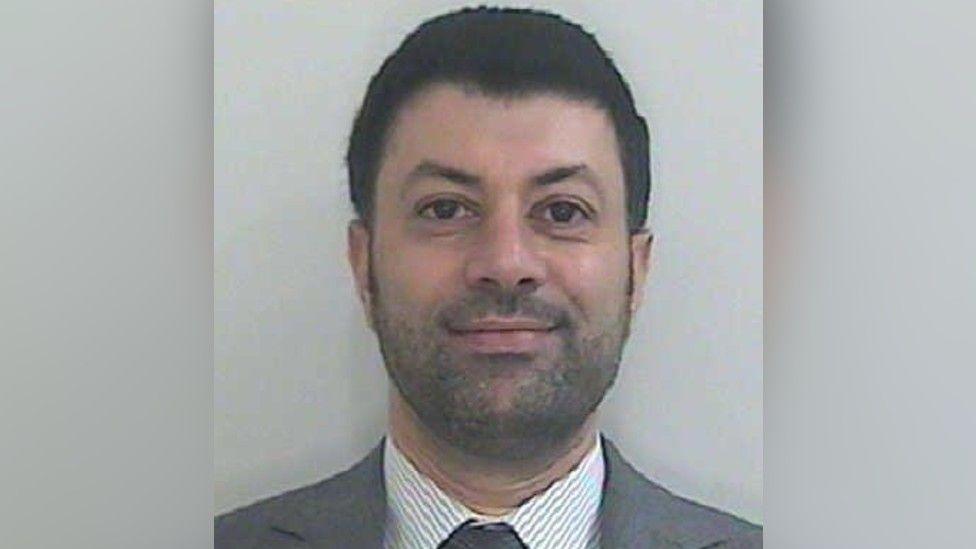

Arif Patel, who masterminded a massive VAT carousel fraud, remains on the run
One of the UK's most prolific fraudsters, described by a judge as a "breathtakingly arrogant" and "totally dishonest" man, remains on the run in Dubai after stealing more than £33m of public money.
Arif Patel, from Preston in Lancashire, was exposed following a complex investigation spanning years, led by His Majesty's Revenue and Customs (HMRC), which established that he had tried to steal as much as £90m.
Patel, who skipped the UK in 2011 never to return, was eventually convicted in his absence and in 2023 was handed a 20-year prison sentence.
Key Developments
BBC File on 4 Investigates has been on the trail of the man who stole from all of us - and seemingly got away with it.
"Al Capone was brought down by the taxman. This is the same situation and 20 years was more than a satisfying result," said Rod Stone, a veteran investigator of large-scale tax fraud, of Patel's conviction and custodial sentence.
The judge at Patel's sentencing hearing described him as the leader of a "fraternal organised crime group" with his brothers Munaf and Faisal who were "truly high-level criminals".
The fact that Arif Patel has not served a single day of his 20-year prison sentence clearly rankles with Stone.
For him and the dozens of others who were involved in bringing Patel down, there remains a strong sense that justice has only been served on paper.
Former HMRC assistant director Rod Stone specialised in the detection of fraud and organised crime
In the early part of the millennium, Arif Patel appeared to be a businessman very much on the up.
His company, Faisaltex, headquartered in his home city of Preston, was known for manufacturing textiles, such as socks and nighties, which it supplied to retailers.
Patel was a fixture in the Sunday Times Rich List with his wealth in 2006 estimated to be £105m. He was also investing heavily in property across the city and beyond.
In 2007, his teenage son bought a minority stake in Preston North End Football Club. There was even a plan to build a £100m, 19-storey tower block - complete with botanical gardens and restaurant - in the centre of the city.
Behind the facade, though, something very different was going on.
In the early 2000s, organised crime groups had turned to large-scale attacks on the tax system through what became known as carousel fraud.
Chains of fake business transactions are created as a way of stealing VAT repayments from HMRC.
Goods move between different companies, into and out of the country, to generate false tax refunds.
The same shipments of goods are often moved around repeatedly, hence the name carousel fraud.
This type of fraud was costing taxpayers billions of pounds a year and experts like Stone were at the vanguard of the fightback.
This is how Patel's textiles empire appeared on his radar.
"When we started to look at them we did notice some very strange shipments of goods - a container load of hats to Switzerland seemed odd because they were actually Swiss hats," he said.
The fake clothes the gang were selling would have been worth up to £50m had they have been genuine
Most carousel fraudsters dealt in high-value, high-volume items like mobile phones or computer chips, for which investigators were on the lookout.
But Patel's enterprise had predominantly been dealing in textiles, making the scam harder to spot.
The team of investigators discovered Patel had successfully stolen more than £33m of taxpayers' money before HMRC cottoned on to what he was doing.
In total, he tried to steal more than £90m of public money - the rest of the payments were stopped.
Teams of investigators spent years working through vast chains of transactions until they were ready to make their move.
Patel was charged with a range of offences including conspiracies to cheat the taxman, money-laundering, false accounting and selling counterfeit goods.
But when he appeared at Bolton Crown Court in 2011, Patel asked the judge for permission to travel to Dubai on bail.
The judge agreed to this request and Patel left the UK, never to return.
In Dubai, he joined his brothers Munaf and Faisal, who had already left the country before they could be charged for their part in the conspiracy.
Over the next three years, 24 members of Patel's gang were convicted. Collectively, they were jailed for more than 116 years.
A judge ordered Patel's Ferrari Superamerica to be auctioned off
Efforts to have Arif Patel extradited back to the UK failed and he remained a free man in Dubai.
The BBC has heard claims he had been actively seeking to strike a deal with the UK authorities to settle the case against him.
"In my opinion, he thought he was above justice," said Graham Honey, another former HMRC investigator.
In 2020, he was working in the private sector when he said he was approached by Patel's representatives.
Honey said he was asked to open up a channel of communication with HMRC and the Crown Prosecution Service because Patel wanted to make a deal.
It soon became clear, however, that there would be a sticking point.
"It started to become apparent to me that Patel was not willing to come back," said Honey.
"He just thought he could get an agreement, pay some money, and this would all go away."
Honey claimed that while Patel was willing to admit his guilt and repay money, he was not prepared to face a criminal trial or the prospect of time behind bars.
He claimed it was not the first time that Patel had attempted to strike such a deal.
Honey said: "One of the officers told me that he had said 'I'm a tiger, not a caged tiger' meaning he was a big man, he'd done what he'd done, but in essence, he wasn't prepared to go to prison for it."
HMRC said it had seized more than £78m of the gang's UK assets
In 2023, Patel's trial got under way without him, something which is highly unusual and only done as a last resort.
He was found guilty of leading one of the UK's biggest carousel fraud gangs and received a 20-year jail sentence.
In 2025, he was subjected to a confiscation order to repay £90.5m through the sale of assets found to have been gained through criminality.
The funds raised were to be returned to the public purse.





